Online Frequency Analyzer
Real-time FFT spectrum analysis showing frequency distribution from 20 Hz to 20 kHz. Identify dominant frequencies and visualize spectral content.
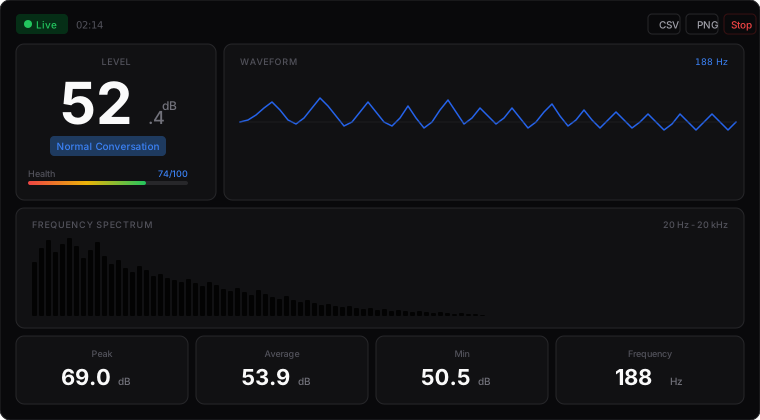
Actual interface shown after microphone access.
Requires microphone access. Audio stays on your device.
Understanding Frequency Analysis
Frequency analysis is a fundamental technique in audio engineering, acoustics, and signal processing. By decomposing a complex sound into its individual frequency components, we can understand tonal characteristics, identify noise sources, and evaluate audio quality.
Our online frequency analyzer uses the Fast Fourier Transform (FFT) algorithm with a 2048-point window to provide detailed spectral resolution.
Frequency Range Reference
Related Tools
Frequency Analyzer FAQ
What is a frequency analyzer?
A frequency analyzer breaks down audio signals into their component frequencies using Fast Fourier Transform (FFT). It shows how much energy is present at each frequency, revealing the spectral content of any sound.
What is FFT analysis?
FFT (Fast Fourier Transform) is a mathematical algorithm that converts a time-domain signal into its frequency-domain representation. It reveals which frequencies are present in a sound and their relative amplitudes.
What is the audible frequency range?
Humans can typically hear frequencies between 20 Hz and 20,000 Hz (20 kHz). Low frequencies (20-250 Hz) are bass, mid frequencies (250-4000 Hz) include most speech, and high frequencies (4000-20000 Hz) are treble.
How do I identify the dominant frequency?
Our analyzer automatically detects and displays the dominant frequency - the frequency with the highest energy in the spectrum.
Can I use this to tune instruments?
While our analyzer shows frequency content, a dedicated tuner app may be more practical. However, you can identify the fundamental frequency of a note - for example, A4 is 440 Hz.
What causes frequency peaks in the spectrum?
Peaks indicate concentrated energy at specific frequencies. Musical notes create sharp peaks, while noise tends to spread energy broadly. Room resonances, electronic hum (50/60 Hz), and harmonics all create distinct patterns.